

Write to us
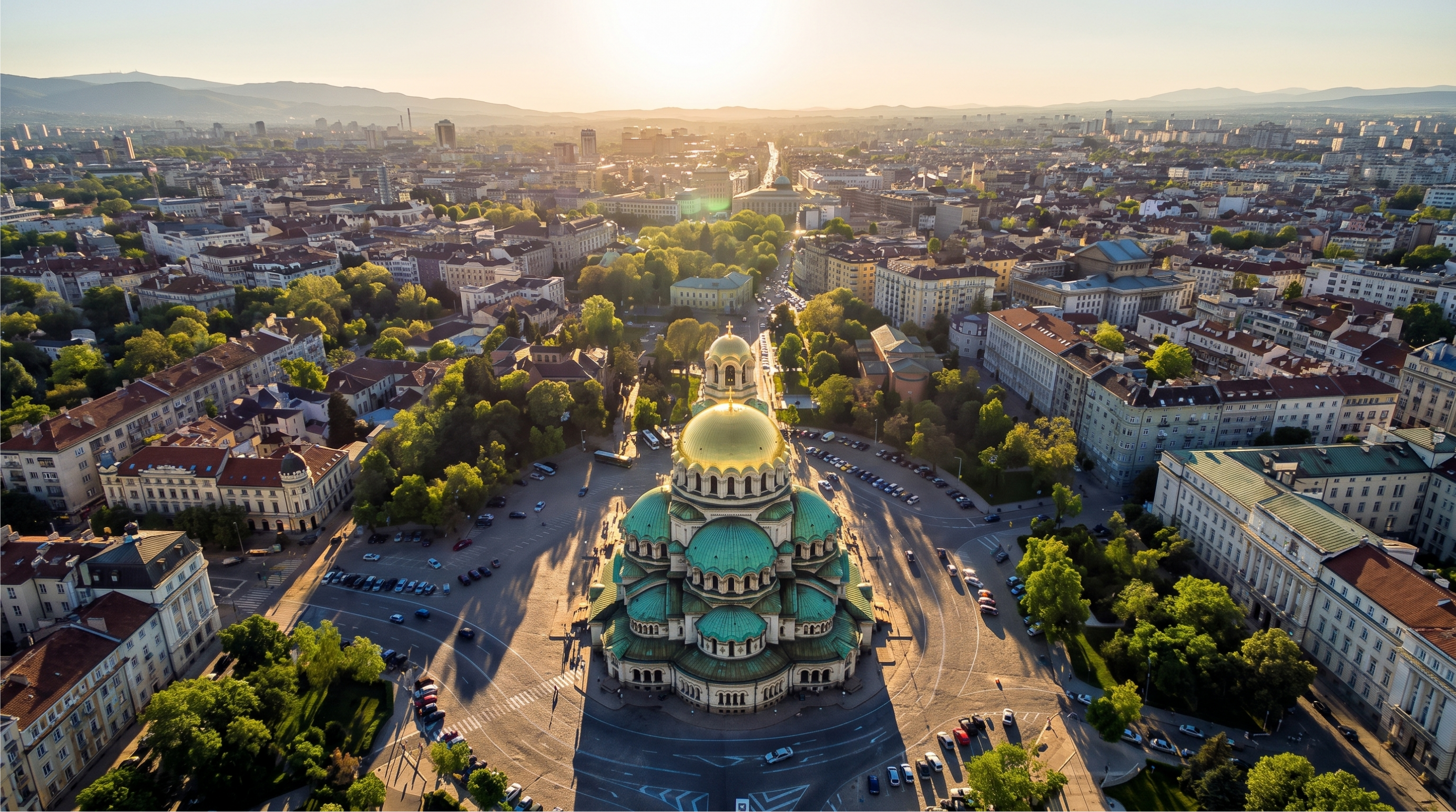
The territory of Bulgaria has been inhabited since antiquity, as the country’s many ancient settlements and burial mounds attest. Present-day Bulgaria was a cradle of some of the earliest civilizations in Europe – the oldest gold ornament ever discovered, unearthed in the Chalcholite necropolis near Varna, is evidence of that. From the age of Ancient Thrace we have inherited valuable cultural monuments, including tombs (such as the Kazanlak tomb, the Aleksandrovska tomb, and the Sveshtarska tomb); treasures (the Panagyursko, Rogozensko, and Valchitransko teasures, among others); and sanctuaries and temples (at Perperikon, Starosel, Kozi Gramadi, Begliktash, and elsewhere).
The cultural interaction between the Thracians and the Hellenistic civilization were particularly dynamic. Many cities and towns heavily influenced by Greek culture were established between 6th-2nd century BC in Thrace, Misia and along the shores of the Black Sea. In the middle of the 1st century AD, all Bulgarian lands became a part of the Roman Empire. Many architectural and archaeological monuments have been preserved from this period, such as the Ancient Theater and the Roman Stadium in Plovdiv, and remains of the Roman cities Ulpia Escus, Nove, Nikopolis ad Istrum, Nikopolis ad Nestum, Augusta Trayana, and Abritus.
After the dissolution of the Roman Empire, the present Bulgarian lands came under the control of the East Roman Empire, later called Byzantium by historians. In the second half of the 7th century, the proto-Bulgarians settled in what is now Northeast Bulgaria. They united with the Slavs to form the Bulgarian state, recognized by Byzantium in 681. The head of the state was the leader of proto-Bulgarians Han Asparuh, and the city of Pliska was declared the state’s capital.
After the dissolution of the Roman Empire, the present Bulgarian lands came under the control of the East Roman Empire, later called Byzantium by historians. In the second half of the 7th century, the proto-Bulgarians settled in what is now Northeast Bulgaria. They united with the Slavs to form the Bulgarian state, recognized by Byzantium in 681. The head of the state was the leader of proto-Bulgarians Han Asparuh, and the city of Pliska was declared the state’s capital.
At the end of the 9th century, the brothers Cyril and Methodius created and disseminated the Slavonic alphabet. Ohrid and Veliki Preslav became centers of the Bulgarian and Slavonic culture. From Bulgaria, the Slavonic alphabet spread to other Slavonic states as well. To the present day, Russia, Serbia, Ukraine, Macedonia and Belarus still use the Cyrillic alphabet, with rules of orthography established by the students of Cyril and Methodius and their followers in the Bulgarian capital Preslav. The reign of Tsar Simeon the First (893 – 927) is famous as the Golden Age of Bulgarian Culture, and the borders of the country at that time reached to the Black Sea, the Aegean Sea and the Adriatic Sea.
During the reign Han Krum (803-814), to the west Bulgaria bordered on the empire of Karl the Great, and to the east the Bulgarian armies reached the gates of the Byzantium capital, Constantinople. In 864, during the reign of Prince Boris I (852-889), Bulgarians adopted Christianity as its official religion, which makes Bulgaria one of the oldest Christian states in Europe.
Unknown History


Representative office address in Bulgaria
Ravda, 7 Laguna Street, office 11A

In 1018, after protracted warfare, Bulgaria was conquered by Byzantium. In 1186, the uprising led by the boyar brothers Asen and Peter, freed Bulgaria from Byzantine rule, establishing the Second Bulgarian Kingdom, with Tarnovo as its capital.